
Your NV Energy bill
Your app says one number and NV Energy says another
Your monitoring reports one production figure and your NV Energy bill shows another. What each one measures, why they cannot match, and when it is a real fault.
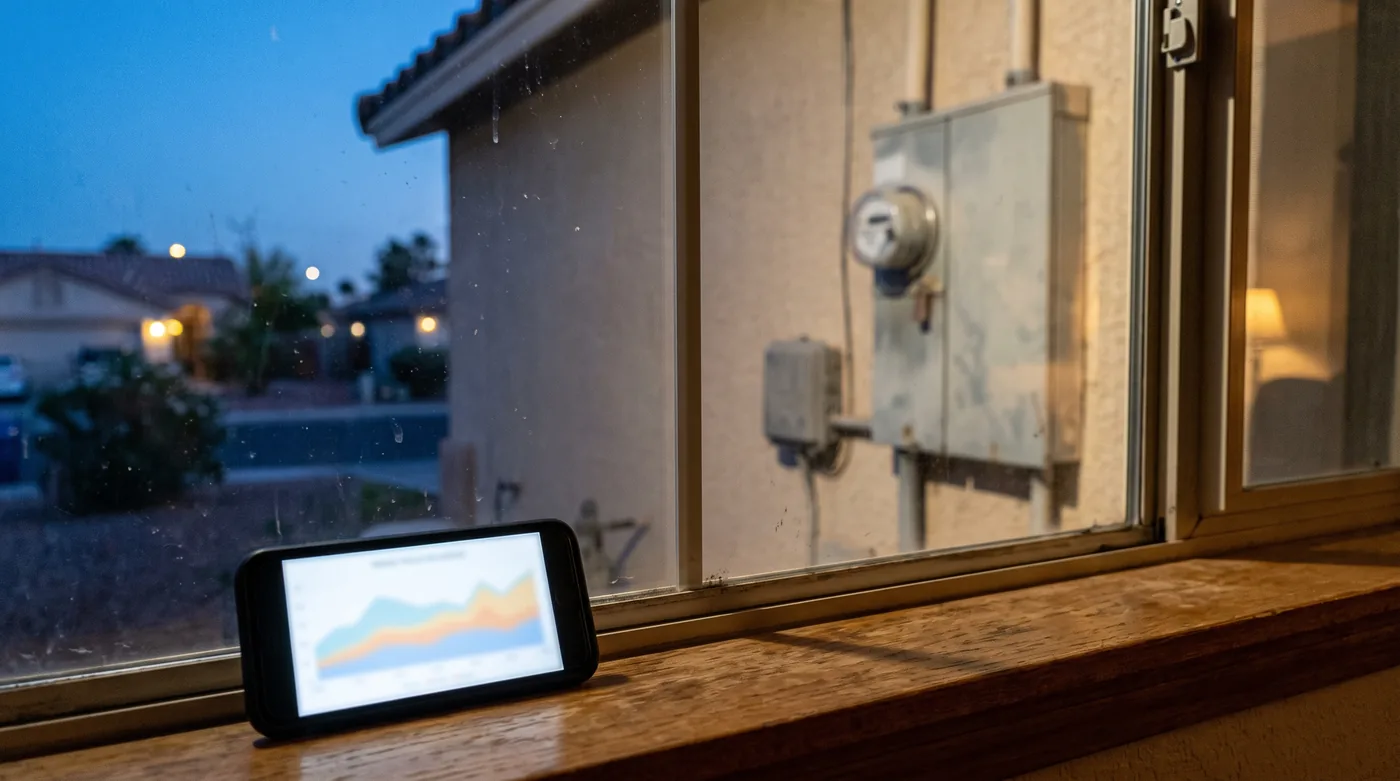
Your monitoring measures what your inverter made. NV Energy measures what crossed the meter. Those are two different quantities, and on a healthy Las Vegas system they are supposed to disagree, usually by a lot. Most of what your roof produces is consumed inside your house the instant it is made and never reaches the meter at all.
Nobody is lying to you. Below are the five reasons the numbers separate, in the order of how much of the gap each one explains, and then the two readings that mean something is actually wrong.
Every figure here comes from NV Energy's own bill guides and rate pages, the Nevada Administrative Code, or a manufacturer datasheet. The worked example uses invented numbers. We do not reproduce anybody's bill.
The two numbers are not the same measurement
NV Energy publishes a line by line guide to a Southern Nevada net metering statement. These are its own definitions of the meter registers.
| Register | What NV Energy says it is |
|---|---|
| kWhD | Kilowatt hours delivered. The energy delivered to your home from the power grid. |
| kWhR | Kilowatt hours received. The excess energy generated by your renewable system that is pushed back to the power grid. |
| kWhG | Kilowatt hours generated. Shown only if you have a generation meter, this is the total amount of energy generated by your renewable system during the billing period. |
Read the middle one again. kWhR is not your production. It is the excess. It is what was left over after your house had taken what it wanted, measured at the point where your service meets the grid.
Your monitoring is measuring somewhere else entirely, at or just after the inverter, before the house takes its share. Two instruments, two locations, two definitions. There is no arrangement of those three registers that will ever equal the number in your app, unless your house draws nothing at all during daylight.
Most Las Vegas homes do not have a generation meter at all, which means the utility has no record of your production. If you have never seen a kWhG line on your statement, that is why. There is more on reading the whole statement in how to read your NV Energy bill once you have solar.
Cause one, and it is most of the gap: the meter never sees self consumption
Take an invented August month on a system that is working perfectly.
| Line | Value |
|---|---|
| What the app reported as produced | 1,420 |
| kWhR, what the meter recorded going back to the grid | 640 |
| The difference | 780 |
Those 780 kilowatt hours are not missing. They ran your air conditioning, your refrigerator and your pool pump at the moment the panels made them. They travelled from the roof to the load centre and stopped. The meter is on the other side of that junction, so it never counted them.
This is also the most valuable energy on the whole system, because it displaces a kilowatt hour you would otherwise have bought at the full retail rate, while an exported one is credited at 75 percent of the retail volumetric rate under NMR-405 Tier 4. What 75 percent of retail actually costs you works that difference through.
So the first thing to understand is that a large gap between the app and the bill is not a symptom. On a correctly sized system it is the point.
Cause two: monthly netting moves the line a second time
NV Energy's net metering answers set out the rule for Southern Nevada. Within a monthly billing period, exported energy is netted against delivered energy. Only if excess remains does the 75 percent credit apply and go into a carryover bank. NRS 704.775 says the same thing in statute: the billing period for net metering must be a monthly period.
NV Energy's own worked example on the NMR-405 page shows 100 kilowatt hours delivered against 30 exported, billed as 70 kilowatt hours, with no credit at all.
So even the export number on your statement gets folded into a subtraction before it reaches a dollar figure. If you are hunting for your production inside the charges on your bill, it has been through two operations by then, and neither of them was designed to report production.
Cause three: the inverter is a ceiling and a toll booth
Between the panels and anything that reports a number, the energy has to change form, and the conversion has both a loss and a limit.
The loss is small and constant. Tesla's Powerwall 3 datasheet, 2025 edition, lists solar to home or grid efficiency at 97.5 percent. Route the same energy through storage first and the datasheet lists 89 percent. Those are Tesla's figures for Tesla's hardware, and every manufacturer publishes its own, but the shape is the same everywhere: a few percent goes as heat on the way through, and more than a few if it passes through a battery.
The limit is larger and it only shows on the best days. The same datasheet says a Powerwall 3 supports up to 20 kW DC of solar while providing up to 11.5 kW AC of continuous power per unit. When the array is capable of more than the inverter will pass, the extra is not produced. That is clipping, it is a deliberate design choice, and it is the reason a proposal that quoted you a DC array size will always sound bigger than anything you ever see reported.
Find the two ratings on your own equipment's spec sheet before you decide a number is wrong. If your app reports at the module and your installer sized the array well above the inverter, an August afternoon flat line at the same figure for three hours is the ceiling doing its job, not a fault.
Cause four: the month on your bill is not the month in your app
Your monitoring resets on the first of the calendar month. NV Energy bills on a read cycle.
The sample statement inside NV Energy's own Understanding Your Bill guide makes the point without needing any interpretation. It shows this month at 29 days and last month at 33 days, and it carries a billing date and a separate next read date several weeks apart.
Four days of August production landing in a July bill will move a comparison by more than most people expect, and in the shoulder months it can flip the sign of the answer. Before you conclude anything, set your monitoring to the exact service period printed on the statement. Most of the complaints we are called about survive only until somebody does that.
There is a smaller version of the same problem inside a single day. Your monitoring stamps each interval on its own clock, in whatever time zone it was configured with, and the utility stamps its intervals on the meter's. Daylight saving, a gateway that lost time, or a device set up by an installer in another state will all shift a day boundary by an hour, which is harmless over a year and very confusing over a Tuesday.
Cause five: the small, real differences in the instruments
These are last because they are genuinely small, but they are not zero.
- Accuracy class. Revenue grade metering is a defined thing. Tesla's Powerwall 3 datasheet lists its AC metering as revenue grade at plus or minus 0.5 percent to ANSI C12.20. Half a percent either way on a 10,000 kilowatt hour year is 50 kilowatt hours before anything at all has gone wrong. Most consumer monitoring is not revenue grade and does not claim to be.
- Where the sensors sit. Clamp on current sensors have to go on the right conductor, the right way round, and be told the right ratio. One installed backwards reports consumption as production. This is a five minute check for an electrician and it is one of the more common findings on an older install.
- Rounding. The meter reports whole kilowatt hours to the billing system. Your app reports to a decimal place or two. Over a month that is noise, and over a day it is visible.
The two readings that mean something is wrong
Everything above is normal. These are not.
- kWhR reads zero in a clear month. Nothing is reaching the grid. In Las Vegas, in a mild month, a working system with any headroom at all exports something. Zero usually means the system is off, an inverter has failed, or the interconnection was never finished.
- Your own production number has fallen against the same month last year and the weather does not explain it. Compare April to April, not April to March. A single module or string reading zero while its neighbours read normally is the clearest version of this.
Either one is worth a licensed electrician on the roof looking at the array, the rapid shutdown devices and the inverter. If the company that installed your system is gone, what to do when your solar company goes out of business sets out the order to do things in, and we run that inspection as a fixed price job whether or not you buy anything else from us.
How to settle it properly, in order
- Pull your own interval data. NV Energy's daily demand page states that residential customers enrolled in MyAccount can already see and monitor their usage in 15 minute increments. That is the same data the utility bills on.
- Line the app up to the service period on the statement, not to the calendar month.
- Compare the right pair. If you have a generation meter, compare kWhG against your app. If you do not, compare kWhR against your app's export figure, never against its production figure.
- Ask for a meter test. NAC 704.343 says a utility shall test the meter of a customer upon his or her request, and that no charge may be made for performing a test once during any 12 month period. You may be present, and you may ask for a qualified representative of the Commission to attend.
- Know what a failed test is worth. NAC 704.344: if the meter is found inaccurate by more than 2 percent, bills are adjusted, back 3 months if it under recorded and back 6 months if it over recorded, and an overcharge must be credited within 30 days of being determined.
- If you are still not satisfied, NAC 704.346 requires the utility to investigate a disputed bill, report its determination, and tell you about your right to file a complaint with the Division.
That sequence costs nothing, it is written into Nevada's own rules, and it ends the argument one way or the other.
One more thing changes in January 2027
A third number is about to appear. NV Energy plans to break a daily demand component out of the energy rate for southern Nevada, priced at $0.14 per kW of your highest 15 minutes of use in a day. It is scheduled for January 1 2027, under appeal. It is measured in kilowatts, not kilowatt hours, so it will not match anything in your monitoring either, and for the same reason: it is a different quantity. We keep that page current at the daily demand charge.
Questions people ask us
Why does my solar app show more production than my NV Energy bill?
Because they are not measuring the same thing. Your monitoring measures what the inverter produced. NV Energy's net meter records kWhD, the energy it delivered to you, and kWhR, only the excess your system pushed back. Everything your house consumed the moment the roof made it never crossed the meter, so it appears in one number and not the other.
Which number is correct, my app or my meter?
Both, for what each one measures. The meter is the billing instrument and it is the one that decides your charges. Your monitoring is the diagnostic instrument and it is the one that tells you whether the array is healthy. Use the meter to check the bill and the monitoring to check the system, and do not expect the two figures to agree.
Can I ask NV Energy to test my meter?
Yes. The Nevada Administrative Code, NAC 704.343, says a utility shall test the meter of a customer upon his or her request, and that no charge may be made for performing a test once during any 12 month period. You may be present, and you may ask for a representative of the Public Utilities Commission of Nevada to be there too.
What happens if the meter is found to be wrong?
NAC 704.344 says that if a meter is tested and found inaccurate by more than 2 percent, the affected bills are adjusted. If the meter under recorded usage the adjustment covers the most recent 3 months. If it over recorded, it covers the most recent 6 months, and the utility must credit the account within 30 days of determining the overcharge.
My app shows production but my bill shows no exports at all. Is that normal?
In a mild Las Vegas month it is not. If kWhR reads zero on a clear month, nothing is reaching the grid, which usually means the system is off, an inverter has failed, or the interconnection was never completed properly. That is worth a licensed electrician looking at the array, the rapid shutdown devices and the inverter.
Does a battery make the gap bigger?
Yes, and it is supposed to. Energy routed through storage is used in the house later instead of being exported, so exports fall while production stays the same. Tesla's Powerwall 3 datasheet also lists solar to battery to home or grid efficiency at 89 percent against 97.5 percent straight through, so a few percent is lost in the round trip.
Where these numbers come from
- NV Energy, Understanding Your Bill, Southern Nevada, NMR-A South (meter register definitions and the sample statement showing a 29 day and a 33 day billing period with separate billing and next read dates) checked 2026-09-20
- NV Energy, Understanding Your Bill, Southern Nevada, NMR-G South (the kWhG definition, shown only where a generation meter is fitted) checked 2026-09-20
- NV Energy, Net Metering Frequently Asked Questions, the definition of monthly netting (read through the site's own content endpoint, because the public page renders its text from script) checked 2026-09-20
- NV Energy, NMR-405 Tier 4 net metering rate page, including the worked netting example (read through the site's own content endpoint) checked 2026-09-20
- NRS 704.775 subsection 1, the billing period for net metering must be a monthly period, Nevada Revised Statutes as posted by the Nevada Legislature checked 2026-09-20
- NAC 704.343, testing meters for accuracy, and NAC 704.344, adjustment of bill when meter inaccurate, Nevada Administrative Code as posted by the Nevada Legislature checked 2026-09-20
- NAC 704.346, resolution of dispute regarding bill, charge or service checked 2026-09-20
- Tesla, Powerwall 3 datasheet, 2025 edition (20 kW DC solar input against 11.5 kW AC continuous output, solar to home efficiency 97.5 percent, solar to battery to home 89 percent, AC metering revenue grade at plus or minus 0.5 percent to ANSI C12.20) checked 2026-09-20
- NV Energy, Southern Nevada Daily Demand, on 15 minute interval usage in MyAccount (read through the site's own content endpoint) checked 2026-09-20
Actual utility rates may go up or down and actual savings may vary. Every figure on this page is an estimate based on the sources listed below, not a promise about your home.
We recheck this page quarterly. Last checked 2026-09-20. If a number here has moved, tell us and we will fix it the same week.