
Battery backup
Before you buy a battery: can a load controller do it cheaper?
A load controller stops a 15 minute peak forming. A battery supplies it. What each reaches, what neither removes, and how to tell which your house needs.
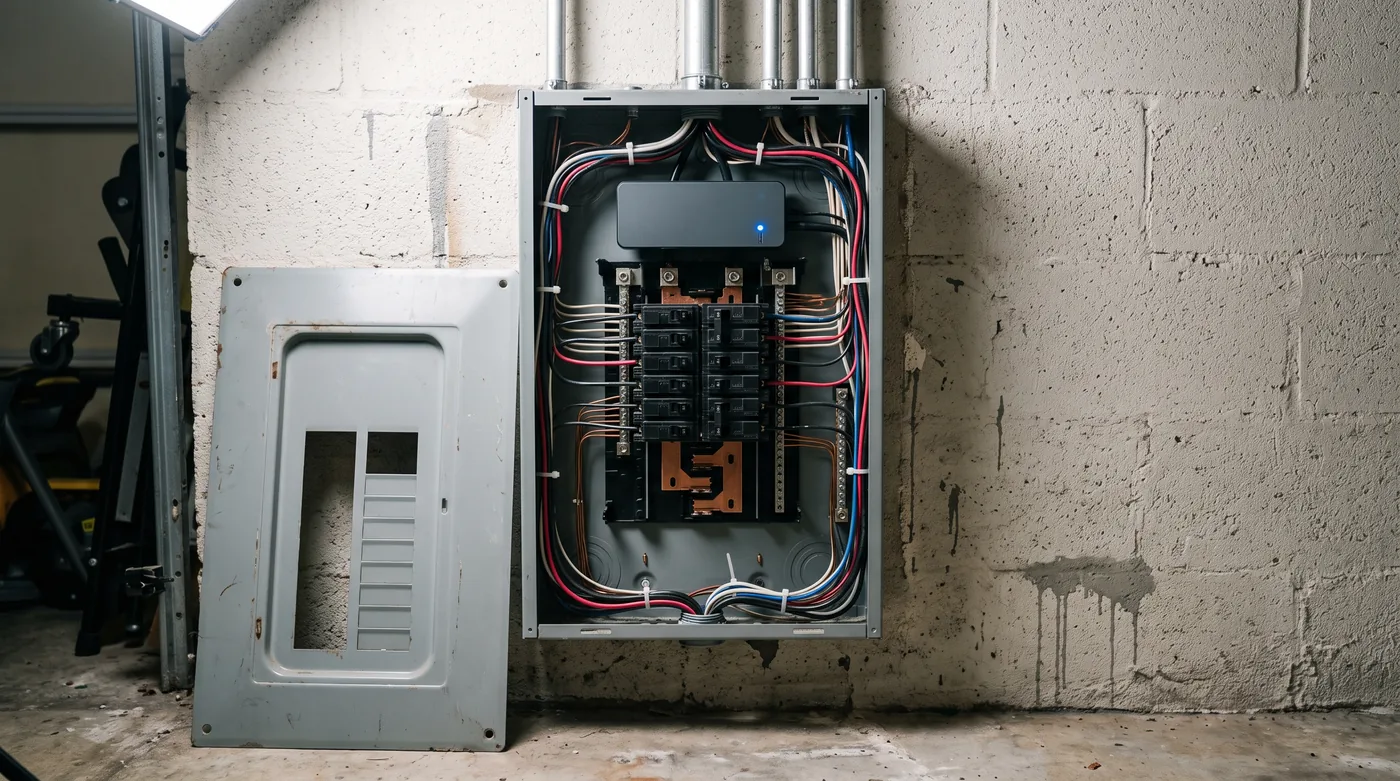
Yes, often, and it costs a fraction of what storage costs. A load controller and a battery solve the same problem from opposite directions: the controller stops a peak forming by taking loads away, and the battery lets the peak happen and supplies it from storage so the meter never sees it. Try the cheaper one first.
The honest caveat is at the front, not buried: a controller cannot reach a load you refuse to interrupt, it does nothing in a power cut, and neither device removes the charge from your bill.
What the charge measures, in one paragraph
NV Energy's daily demand fact sheet, dated June 2026, says the charge is calculated on each customer's highest 15 minute interval of electricity use, that it resets every day of the month, and that those daily peaks are totalled over the billing period. NV Energy's own page puts the rate at $0.14 per kW and says a typical southern Nevada household peaks near 3.5 kW, which is about $0.49 a day, with an expected average bill impact between $15 and $20 a month. It is scheduled for January 1 2027, under appeal to the Nevada Supreme Court after a Las Vegas judge denied the challenge in May 2026. The full picture is in NV Energy's daily demand charge explained, and the litigation is tracked at the demand charge court case.
Two consequences run through everything below. The charge is priced on power, so using fewer kilowatt hours does not touch it. And NV Energy's own answer says it is not a time of use rate, that the cost is the same every hour of every day, so a 2 in the morning peak costs the same as a quarter to seven one.
The two mechanisms, side by side
Your house asks for 8 kilowatts at ten past four on an August afternoon. Two ways to stop the meter recording 8.
A controller takes the request away. It opens a circuit, or holds one off, so the load that would have stacked on top never runs. The peak does not form.
A battery answers the request. The house still draws 8 kilowatts, but 4 of them come out of storage, so the grid side of the meter records 4.
That difference sounds academic. It is not, and it decides which one is right for your house.
| Load controller | Battery | |
|---|---|---|
| What it does at the moment of peak | Removes load | Supplies load |
| Loads it can reach | Only ones you allow it to interrupt | Every load in the house, up to its power rating |
| Effect on comfort | You give something up, briefly | Nothing changes |
| During a power cut | Nothing. It is not a power source | Runs the house, within its rating |
| On NV Energy's time of use plan | Can move a load out of an expensive window | Can supply the whole window from stored energy |
| Relative cost | Far lower | Far higher |
| What it needs from you | Decisions about what may be interrupted | Sizing against your own interval data |
What a load controller actually is
The category is wider than most quotes make it sound, and the four kinds are not interchangeable.
A panel that replaces your panel. SPAN's smart panel page describes 16 to 48 controllable circuits and real time on and off control over every circuit in the home. SPAN calls the product "a certified Energy Management System" that monitors "electrical loads throughout the home" and pauses "pre-selected circuits on rare occurrences when total consumption temporarily exceeds the home's maximum electrical capacity." Worth knowing before you budget for one: SPAN's page states that this load pausing function is currently available primarily for electric vehicle charger loads. That is a narrower thing than whole home peak shaving, and it is the manufacturer saying so.
A controller that works beside the panel you already have. Lumin's product pages describe staying "within your service panel's capacity limits with built-in load management" and reaching "whole-home energy management without replacing your breaker panel or adding a protected loads panel." Fewer circuits under control, a smaller electrical job, and you keep the equipment you have.
A charger that manages itself. An electric vehicle charger is the single largest steady load most Las Vegas homes add, and it is the easiest one to control, because nobody minds if the car finishes at 3 in the morning instead of 11 at night. Charger side load management is the cheapest useful control in this whole article and it is often already sitting in the settings of a charger you own.
A monitor that only watches. Emporia's pages describe monitoring energy usage in real time down to individual circuits and appliances. That is measurement, not control, and it will not move your peak by a single watt. It is still the most useful first purchase for some houses, because you cannot size any of the above until you know which circuit is setting the peak.
The arithmetic, on a house with a real problem
Take the same house we use on can a battery get you out of the demand charge: two condensers and a vehicle charger, and a genuine 8 kilowatt quarter hour on a summer afternoon. At $0.14 per kilowatt:
| Highest 15 minutes | Per day | 31 day month | |
|---|---|---|---|
| Nothing done | 8.0 kW | $1.12 | $34.72 |
| Controller stops the charger overlapping, 2 kW off the peak | 6.0 kW | $0.84 | $26.04 |
| Controller also sequences the dryer and the oven, 3 kW off | 5.0 kW | $0.70 | $21.70 |
| Battery holds the grid draw at a 4 kW ceiling | 4.0 kW | $0.56 | $17.36 |
Read the middle rows before the last one. The controller took roughly three quarters of the reduction the battery achieved on this house, and the two things it interrupted were a car that charges overnight anyway and a dryer that does not care what time it runs.
That is the case for trying the cheap thing first, and it is the arithmetic we will show you rather than a slogan. It also shows the limit. The controller ran out of things it was allowed to switch off at 5 kilowatts, and the battery kept going because it was not switching anything off at all.
The load a controller cannot reach
In Las Vegas the floor under a summer peak is almost always air conditioning, and air conditioning is the one load a household will not let a device interrupt at four in the afternoon in August.
So the practical ceiling on a controller is this: it can stop everything else from stacking on top of the air conditioning, and it cannot go below the air conditioning. If you pull your own 15 minute data and find the worst quarter hour of July was two condensers running together with nothing else on, a controller has almost nothing left to shed, and the only tool that reaches further is storage.
That is why the order matters. Measure first, then decide. NV Energy's daily demand page says residential customers enrolled in MyAccount can already see and monitor their usage in 15 minute increments, which is the same resolution the charge will be billed on.
What a controller cannot do at all
Three things, and any of them on its own can decide the question.
It is not a power source. When the grid goes down, a load controller sits in the dark with everything else. A battery runs the house. Tesla's Powerwall 3 datasheet lists 13.5 kWh nominal battery energy and up to 11.5 kW AC continuous per unit, with 185 LRA load start capability, which is the specification that decides whether a condenser will actually start on it. Backup is a value that never appears on a utility bill and it is frequently the real reason people buy storage.
It cannot arbitrage the evening. On NV Energy's time of use plan the gap between a summer on peak kilowatt hour and an off peak one is the largest number in this whole subject, and it is not a demand charge question at all. A controller can move a load out of that window. A battery can supply the window. We work that through in why a battery pays for itself between 6 and 9 pm.
It cannot store your exports. Under Tier 4 an exported kilowatt hour is worth 75 percent of the retail volumetric rate while one you use in the house is worth the full rate. A controller cannot convert one into the other. A battery does exactly that, every evening, without anybody remembering anything.
Neither one removes the charge
Say this plainly, because a lot of quotes will not.
The daily demand line will appear on your bill on January 1 2027 whatever you install. A controller lowers the peak it is measured on. A battery lowers it further. Nothing takes the line off the page, nothing gets the number to zero, and any company telling you otherwise is selling.
There is also a question nobody can answer honestly yet, which we cover on the battery page: no equipment sold today is configured against a charge that does not exist. Present day settings are built around time of use pricing and backup reserve, not around a flat daily charge measured on a 15 minute window. Ask in writing what a given product will do on January 1 2027 and who changes the setting. We put ours in the written quote.
Two rules from NV Energy's handbook, if storage is where you land
Both come from the Net Metering and Energy Storage Interconnection Handbook, revision 7 dated October 16 2025.
Adding storage on its own does not move your net metering rate. The handbook: a system expansion that only adds an energy storage system, and does not add any additional renewable capacity, will not result in a net metering rate change. Adding panels is the thing that moves you.
Battery backup needs approval before it goes in. The handbook requires advance review and approval by NV Energy for the use of a battery backup system on a grid connected system. That is part of the permitting and interconnection work, and it is why a storage job takes longer than a controller job.
Neither rule applies to a load controller, which is one more reason it is the faster thing to try.
How to decide, in order
- Pull your last 12 months of 15 minute data from MyAccount. Free, and it is the only evidence about your own house.
- Find the single worst quarter hour of July. Multiply it by $0.14. That is your bad day under the new structure.
- Work out what was running in it. If it was the air conditioning alone, skip to storage. If two or three separate large loads overlapped, you have a controller problem, which is the cheaper problem to have.
- Do the free things first. Move the dryer, the oven and the dishwasher apart. Set the vehicle charger to start late. Run the pool pump outside the hottest part of the afternoon. Then look at the data again a month later.
- Price the control against the storage on the same sheet of paper, including backup and the evening window, not on the demand charge alone.
We will do steps one through three with you at no charge and tell you if the answer is that you need neither. Whichever way it goes, it is licensed electrical work on your service equipment, our own crew does it, and the permit is in the written price.
Questions people ask us
Can a load controller replace a battery for the demand charge?
Sometimes, and it costs a fraction of what storage costs. A controller stops two large loads running at the same moment, so the peak never forms. What it cannot do is help with a load you refuse to interrupt, which in a Las Vegas August is air conditioning. If your peak is set by the air conditioning alone, a controller has very little left to shed.
Does a load controller lower my demand charge?
It lowers the peak the charge is measured on, which lowers the number. NV Energy's daily demand is $0.14 per kilowatt of your highest 15 minute interval each day, totalled over the billing period, so every kilowatt you keep off that interval is 14 cents a day. It is scheduled for January 1 2027, under appeal. Neither a controller nor a battery removes the line.
What is the difference between a smart panel and a load controller?
A smart panel is one kind of load controller. It replaces your existing panel and gives you switching on every circuit. Other controllers sit beside the panel you already have and switch a handful of chosen circuits. Some devices only measure and never switch, which is useful for finding your peak but does nothing to it.
Will a load controller turn off my air conditioning?
Only if you tell it to, and most households will not. That is the honest limit of the approach. Air conditioning is usually the floor under a Las Vegas peak rather than the thing on top of it, so a controller works by keeping everything else from stacking on top of the air conditioning, not by removing it.
Do I need a panel upgrade to add a controller?
It depends on the product and on your existing service. A panel replacing controller is electrical work on your service equipment and needs a permit and an inspection. A controller that sits alongside your panel is usually a smaller job. Either way it is licensed electrical work and it should be quoted with the permit in the price.
Should I just do the free things first?
Yes, and we will tell you that before we quote you anything. Spreading the dryer, the oven, the dishwasher and the vehicle charger across different parts of the day costs nothing and works, because the charge is priced on things happening at the same time. Pull your 15 minute data first and find out what is actually setting your peak.
Where these numbers come from
- NV Energy, Southern Nevada Daily Demand, guide and frequently asked questions, including the $0.14 per kW figure, the 3.5 kW typical peak, the $0.49 per day and $15 to $20 a month expectation, that it is not a time of use rate, and 15 minute usage in MyAccount (read through the site's own content endpoint, because the public page renders its text from script) checked 2026-09-20
- NV Energy, Daily Demand fact sheet PDF, dated 2026-06, on the highest 15 minute interval, the daily reset and the totalling across the billing period, and the January 1 2027 start checked 2026-09-20
- KTNV Las Vegas, Nevada lawmakers decline taking on NV Energy's daily demand charge (the challenge was denied in May and is on appeal to the Nevada Supreme Court, with no future hearings scheduled as of publication) checked 2026-09-20
- SPAN, Smart Panel product page, on 16 to 48 controllable circuits and the panel operating as a certified Energy Management System that pauses pre-selected circuits when total consumption exceeds the home's maximum electrical capacity checked 2026-09-20
- Lumin, product home page, on load management that keeps a home within its service panel's capacity limits without replacing the breaker panel checked 2026-09-20
- Emporia Energy, product home page, on circuit level and appliance level energy monitoring in real time checked 2026-09-20
- Tesla, Powerwall 3 datasheet, 2025 edition, on 13.5 kWh nominal battery energy, up to 11.5 kW AC continuous power per unit, and 185 LRA load start capability checked 2026-09-20
- NV Energy, Net Metering and Energy Storage Interconnection Handbook, revision 7 dated 10/16/2025, on storage only expansions not changing the net metering rate and on battery backup requiring advance review and approval checked 2026-09-20
Actual utility rates may go up or down and actual savings may vary. Every figure on this page is an estimate based on the sources listed below, not a promise about your home.
We recheck this page monthly. Last checked 2026-09-20. If a number here has moved, tell us and we will fix it the same week.