
Solar Rescue
How to find out if your solar system still works
Four checks you can do yourself, in order, using your own NV Energy bill and the equipment on your wall. No app, no login and no installer required.
Start with your bill, not your roof. If your system is producing and sending anything back, your NV Energy statement records it every month, whether or not an app is working and whether or not the company that installed it still exists. A month that used to show exported energy and now shows none is the clearest single sign that production has stopped.
Four checks, in this order. You can do all of them yourself, today, without a login and without calling anyone.
1. The export line on your bill
Under NMR-405, NV Energy nets what it delivered to you against what you exported inside each monthly billing period. Only the surplus that survives that netting is credited. NV Energy's own page works two examples: deliver 100 kWh and export 30, and there is no excess credit because more came in than went out; deliver 30 and export 100, and the 70 kWh difference is credited.
What matters for a diagnosis is not the credit. It is whether anything was exported at all.
Find the export figure on this month's statement, then find it on the same month a year ago. How to read your NV Energy bill once you have solar shows where each line sits on a Southern Nevada net meter statement.
| What you see | What it usually means |
|---|---|
| Export similar to the same month last year | The system is working |
| Export much lower than the same month last year | Part of the system has stopped, or something is shading or soiling the array |
| No export at all, in a month that used to have some | Production has stopped, or the meter is no longer seeing it |
| Export normal but your bill still rose | The system is fine. The bill moved for another reason |
That last row catches people out. Netting happens monthly, and credits cannot be applied to the basic service charge, to additional meter charges or to local government fees. So a bill can go up while the panels are working perfectly. Net metering in Nevada sets out what the credit can and cannot pay for.
2. The inverter on the wall
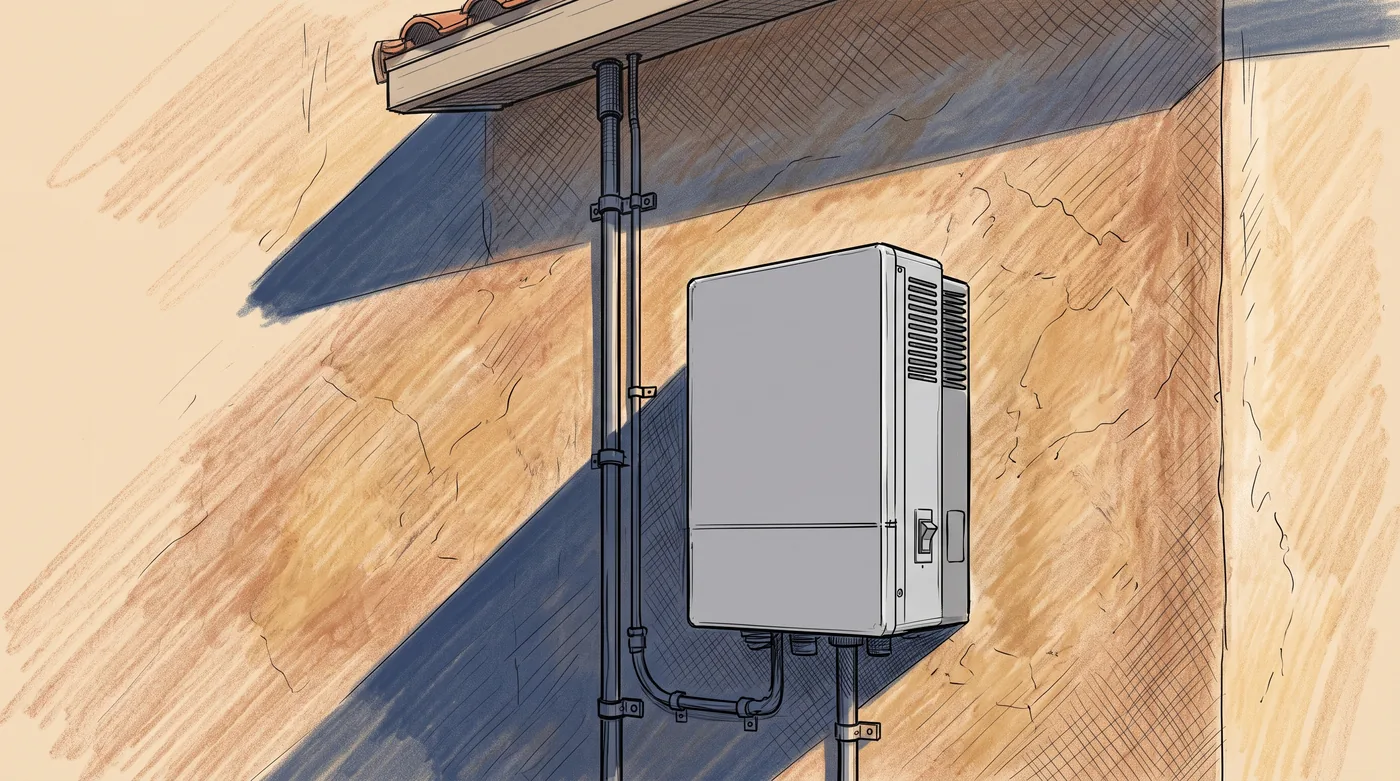
The inverter is the box that turns what the panels make into the electricity your house uses. It is usually in the garage, or outside near the meter. It is the single most common thing to fail, because it is the only part of the system with hard-working electronics in it.
In daylight, look at it.
- A running indicator, usually green. It is producing. Move to check three.
- Nothing lit at all. It is not producing. Note that and stop.
- A red or amber light, or a code on a small display. It has faulted. Photograph the code exactly as shown.
Do not open it, and do not touch the wiring. There is live direct current coming down from the roof during daylight even when the rest of the system is off. What you are doing here is reading a light, not servicing equipment.
Write down the make and model from the label while you are standing there. You will be asked for it by anyone you call, and it decides which manufacturer warranty applies.
3. Compare against your own history
The most common wrong conclusion is drawn by comparing this month with last month. Output in Las Vegas changes with the season by design, so a September figure below a June figure tells you nothing at all.
Compare the same month against the same month a year earlier. Same roof, same orientation, same weather pattern, same house. You can pull twelve months of your own kilowatt hours, including the interval data behind them, straight from NV Energy: how to pull your last 12 months of NV Energy usage walks through it.
Two patterns are worth separating.
A slow, small decline year on year is expected. Panels are built to lose a little output each year, and the rate is written into the manufacturer's warranty for your specific panels. Read that document rather than a general figure.
A sudden step down between one month and the equivalent month a year before is a fault until proven otherwise. Systems do not gradually drift down by a third. They either age slowly or something stops.
4. Did only part of it stop?
Panels are wired in groups, and the groups feed the inverter separately. If one group drops out, the rest carry on. Production does not go to zero; it goes to a share of what it was.
This is the failure that hides the longest, for three reasons. The array still looks normal from the street. The bill still shows some export, so nothing looks alarming. And the monitoring app, if anyone is still watching it, often still reports a system that is online.
If your same-month comparison lands at roughly half, or roughly two thirds, suspect this before you suspect the panels themselves.
What about the monitoring app?
Treat it as the last check, not the first.
Monitoring runs over your home internet and a manufacturer's account. A router change, a new password, a dead sensor or a closed account can all stop the app while the system keeps producing normally. The reverse happens too: an app can keep showing yesterday's cheerful number after production has stopped.
There is a second reason not to lead with it. The figure in the app and the figure NV Energy bills you on are measuring different things at different points, so they do not agree even on a perfectly healthy system. Your app says one number and NV Energy says another explains which is which.
Your bill is the independent record. Start there, and use the app afterwards for detail.
What to do with what you found
Write down four things before you call anyone:
- The month the export changed, from your bill.
- What the bill showed before and after.
- Whatever the inverter is showing, including any code, photographed.
- The make and model from the label.
That page of notes is the difference between a service call that starts with a diagnosis and one that starts with an hour of someone working out what you have.
If the company that installed the system has closed, the order of operations changes, because your manufacturer warranties usually survive the installer while the workmanship warranty usually does not. Your solar company went out of business. What now? covers what survives, what does not, and how to read the court record yourself.
If you would rather someone else did the checking, we inspect existing systems whoever installed them, and we will tell you what we find whether or not there is work in it for us.
Questions people ask us
How can I tell if my solar panels are still working?
Start with your NV Energy bill, not the panels. If your system is exporting, the bill shows energy you sent back during the month. A bill that suddenly shows no export at all, in a month when it used to, is the clearest single sign that production has stopped. The equipment checks come after that.
My monitoring app stopped working. Does that mean the system is down?
No. The app and the system are two different things. Monitoring runs over your home internet and a manufacturer's account, and either can fail while the panels keep producing normally. The reverse is also true. Your bill is the independent record, which is why it is the first check rather than the last.
My system is producing less than last year. Is that a fault?
Not necessarily. Output changes with the season, and panels lose a small amount of output each year by design. Compare the same month against the same month a year earlier rather than against last month. A slow decline is normal. A sudden drop, or roughly half of what you expect, is worth investigating.
What does it mean if only half my normal production shows up?
Panels are wired in groups. If one group stops, the rest keep producing, so the total falls by a share rather than to zero. Roughly half is a common pattern. It is also the kind of fault that hides for months, because the system still looks alive from the street and the bill still shows some export.
Who fixes it if the company that installed it has closed?
Your manufacturer warranties usually survive the installer, because they come from the people who made the panels and the inverter, not from the company that fitted them. The workmanship warranty normally does not. What to do first, and in what order, is set out in our page on what happens when your installer goes out of business.
Can I check production without logging into anything?
Yes. Your NV Energy bill shows what you exported, and the equipment on your wall shows whether it is running. Between them you can tell whether the system is working without a single password. The monitoring app only adds detail once you already know the answer.
Where these numbers come from
- NV Energy, NMR-405 Tier 4 net metering page, on monthly netting of delivered against exported energy and the two worked billing examples (read through the site's own content endpoint, because the public page renders its text from script) checked 2026-09-21
- NV Energy, net metering overview for residential customers checked 2026-09-21
- NV Energy, Net Metering and Energy Storage Interconnection Handbook, on the interconnection record for an installed system checked 2026-09-21
Simmons Solar Electric is not affiliated with, authorised by, or acting for any company named on this page, or for its trustee or estate. We do not honour another company's workmanship warranty. Everything stated here about a company is public record, with its source listed below.
We recheck this page quarterly. Last checked 2026-09-21. If a number here has moved, tell us and we will fix it the same week.