
Permits, HOAs and inspections
Solar permits in Las Vegas, Henderson, North Las Vegas and Clark County
Four jurisdictions, four different paths for a rooftop solar permit. Which desk your address belongs to, what each one asks for, and what a battery changes.
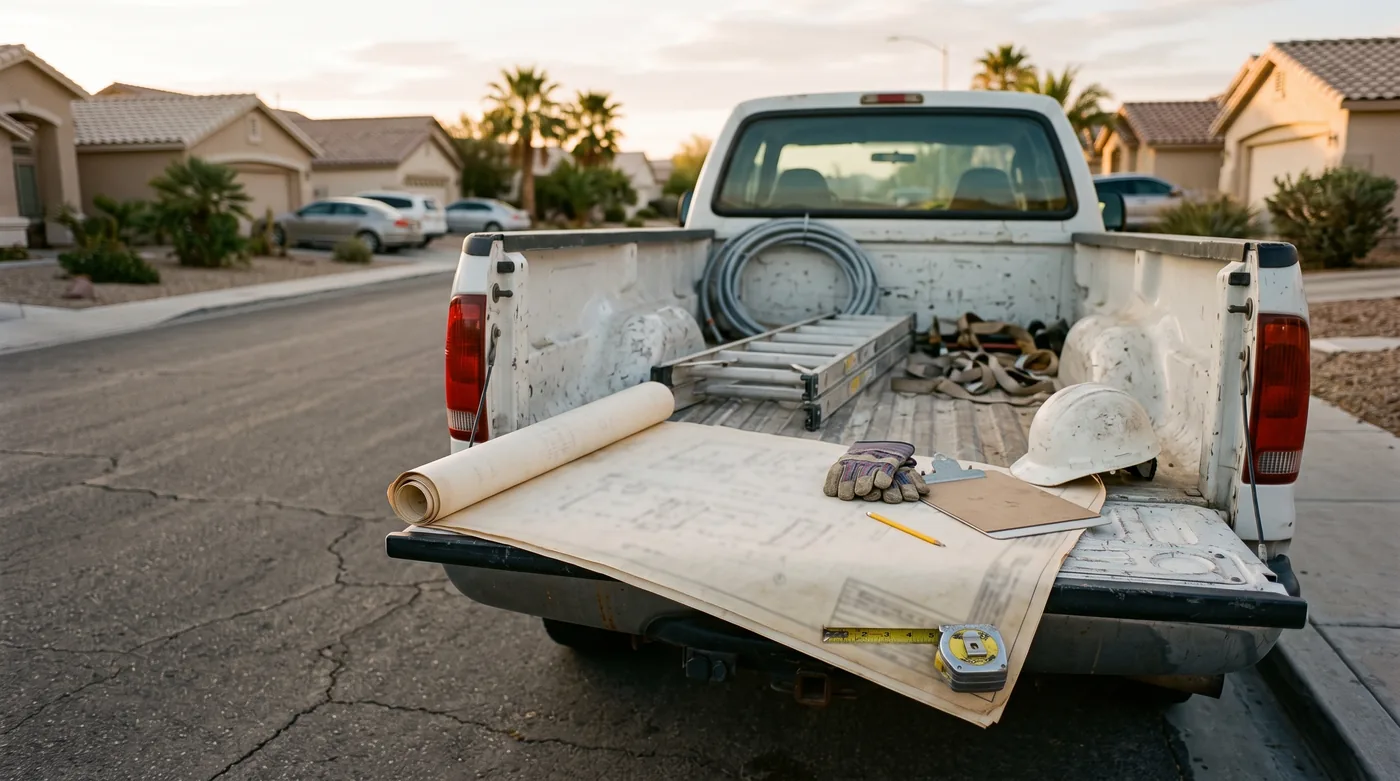
roof-plan-pathways-setbacksYour address decides your permit desk, not your mailing city. A rooftop solar permit in the Las Vegas valley is issued by one of four authorities: unincorporated Clark County, the City of Las Vegas, the City of Henderson or the City of North Las Vegas. Each one publishes its own rules, its own portal and its own list of things that push your job out of the fast lane and into a full plan review.
This page is the primary source version. Every rule below is quoted from the jurisdiction's own current document, with the document's own date, and every document is linked at the bottom. If one of them changes, this page changes and the checked date at the top changes with it.
First, find out which desk is yours
A Las Vegas mailing address is not proof that you are in the City of Las Vegas. Very large parts of what everyone calls Las Vegas, including Spring Valley, Enterprise and Paradise, are unincorporated Clark County and are permitted by the county. The City of Las Vegas building page says it first: make sure you are within the city jurisdiction, and it links the Clark County jurisdiction lookup so you can check a parcel. That lookup is the first thing we open when we quote a roof.
| Where the parcel is | Who issues the permit | Where the application goes |
|---|---|---|
| Unincorporated Clark County | Clark County Building Department | Citizen Access Portal |
| City of Las Vegas | Department of Community Development, Building and Safety Division | The city Dashboard and citizen portal |
| City of Henderson | Development Services Center | DSC Online |
| City of North Las Vegas | Building Safety Division, Permit Application Center | Citizen Self-Service |
One of the four asked installers to run every design through SolarAPP+, the federal instant review service, and stopped three weeks later. None of the other three publishes a SolarAPP+ path at all. We set that out below, because it is the fact most permit pages about this valley still get wrong.
Unincorporated Clark County
The Clark County Building Department at 4701 West Russell Road issues the permit. The rules for a rooftop array are in one document, policy BD-PP-206, Solar Photovoltaic Requirements, effective September 15, 2014 and revised April 30, 2026. Its header names the codes it is written against: the 2024 IFC, the 2024 IBC, the 2024 IRC, ASCE 7-22 and the 2023 NFPA 70, which is the National Electrical Code. The county's own codes library says the 2024 International Codes were adopted effective January 11, 2026, so a design drawn to the old codes is now a correction notice.
What the county wants to see. BD-PP-206 sets two thresholds that decide how much paper your job needs:
- No electrical plan review is required for a system that does not exceed 5 kW.
- Engineer designed plans are required for any new system of 25 kW DC or greater, and for an addition or modification when the total system reaches 25 kW DC.
On the structural side the policy lets the Building Official waive the detailed submittal package and the engineering for a residential install, but only if it meets every one of these: roof mounted and not above the existing building height, no more than 4 pounds per square foot, panels parallel to the roof plane, mounted within 24 inches of the roof below, connection points no more than 48 inches on center, and for wood construction anchored to solid rafters or solid blocking with at least one 5/16 inch lag screw embedded at least 2 and a half inches. You also provide a layout plan showing where every component goes. Anything outside that list needs sealed calculations and installation details, which the policy says do not require a structural plan review.
Fire access, which is what limits how many panels fit. BD-PP-206 requires not fewer than two 36 inch wide pathways on separate roof planes from the lowest roof edge to the ridge, and one of them has to be on the street or driveway side. Each roof plane carrying an array needs a 36 inch pathway of its own. At the ridge, an array covering 33 percent or less of the plan view roof area needs an 18 inch setback on both sides; above 33 percent it is 36 inches. If the house has an automatic sprinkler system installed to IFC 903.3.1.3, those coverage thresholds move to 66 percent. Panels may not be placed below an emergency escape and rescue opening, and a 36 inch pathway to that window is required. Roofs with a slope of 2 in 12 or less are excepted from the roof access requirements.
Manufactured and mobile homes. The policy is blunt: Clark County does not issue permits for photovoltaic systems attached to manufactured or mobile homes. That work goes to the State of Nevada Housing Division.
Fees. The county does not publish a flat residential photovoltaic fee. It publishes a fee calculator, labelled estimates only, and says final fees are calculated by county staff at fee work up. If a company quotes you an exact Clark County permit fee before an application exists, ask them where the number came from.
Timing. Clark County publishes first review service goals rather than promises. Residential minor projects, which is the category a retrofit array falls into, have a 14 day first review goal, with 10 days for corrections and all subsequent reviews.
City of Las Vegas
The Building and Safety Division of the Department of Community Development issues the permit, and the city runs the fastest residential path in the valley.
Under the city's Residential Photovoltaic (Solar) Permits sheet, effective February 15, 2024, a residential array with no energy storage system and no ballasted racking can be issued the same day online. The applicant has to be a licensed electrical contractor, and the submittal is signed electrical plans plus an electrical load calculation uploaded on the city Dashboard. Installations with a battery or a ballasted system go to full plan review and are not eligible for same day issuance.
The city's February 15, 2024 industry advisory lists everything that still has to go through plan review: owner builder installations, ballasted systems, anything containing an energy storage system, commercial installations and ground mounted installations.
The SolarAPP+ detail nobody else has right. On January 24, 2024 the city announced that from February 5, 2024 licensed electrical contractors would have to get the design approved on SolarAPP+ first, at a 25 dollar charge per design, and upload the resulting checklist. Three weeks later the city reversed it. The February 15, 2024 advisory says the city had been piloting SolarAPP+ for two weeks and that, after further review of the process and its limitations, effective at end of the business day on February 15, 2024 it would no longer require the SolarAPP+ checklist. In its place the contractor uploads the signed electrical plans and the load calculations. A page that tells you Las Vegas runs on SolarAPP+ is describing three weeks in February 2024.
What the plans must show. The city's Photovoltaic Installation Guidelines, updated March 26, 2025, list the submittal: the application, a site plan showing where the major components sit, an electrical plan and calculations covering the array and any energy storage system, structural design and calculations sealed by a Nevada licensed engineer for commercial permits and for any ballasted system, and specification sheets and installation manuals for the modules, inverters, combiner box, disconnects and mounting system. The guidelines also set the DC conduit marking: red background, white lettering, minimum 3/8 inch capitals, every 10 feet and at turns and penetrations.
Fees, published. The city's fee tables, Table 3-D, effective July 1, 2021, price a photovoltaic system as three power apparatus with up to 10 kW included in the base fee: 102 dollars plan check and 259 dollars permit and inspection. Each additional 10 kW adds 60 dollars plan check and 53 dollars permit and inspection. A separate online permit issuance charge of 55 dollars applies once per inspection project.
Note what is not on the city's list of permits that need no plan: solar. A residential array is a same day permit, but it is still a permit with documents attached, not a counter transaction.
City of Henderson
Henderson runs its own Development Services Center and its own portal. Applications go through DSC Online at dsconline.cityofhenderson.com, and the application type is Photovoltaic, Residential.
The governing document is the Residential Photovoltaic Roof Mounted Solar Panels Application Submittal Checklist, updated August 20, 2024. Two things make Henderson different from its neighbours.
First, the submittal package includes photographs. Henderson asks for a clear photo of the roof before the modules go on, and says a satellite or aerial image is acceptable as long as it is unobstructed. It also asks for a clear photo of the main electrical service showing the panel, all the circuit breakers and a legible label inside the panel, before any modifications. On top of that it requires a completed Residential Photovoltaic System Permit Authorization signed by the legal property owner, which acknowledges that the owner approves the contractor applying for the permit, plus an Owner Builder Affidavit of Exemption if the owner is pulling the permit for their primary residence.
Second, Henderson decides between a plan review and a field check. The checklist says plan review by the building plan examiners is required if any of these apply: the system meets or exceeds 15 kW DC, it is free standing rather than roof mounted, it is on a mobile or manufactured home, it has a battery backup or energy storage system, the main electrical panel is being upgraded or replaced, the main breaker is being de-rated, or this is an addition to or modification of an existing system. If none of those apply, in-field verification is completed by building inspection staff instead. The same checklist states that an application meeting any of those conditions is subject to a five business day in-house plan review. That is Henderson's own published review target, not a promise about your job, and we do not publish a turnaround of our own until we have measured it on our own installs.
The fire access numbers Henderson cites match the county's: two 36 inch pathways from the lowest roof edge to the ridge with one on the street or driveway side, an 18 inch ridge setback at 33 percent coverage or less, 36 inches above that, 66 percent thresholds where the dwelling has sprinklers, and nothing below an emergency escape and rescue opening.
Fees, published and specific. Henderson's Schedule of Fees, effective October 1, 2025, Table B, prices a residential photovoltaic system at 700 dollars up to 10 kW and 176 dollars for each additional 10 kW in the same system. A battery system of one to three batteries is 239 dollars, each additional battery 71 dollars, and a panel changeout 127 dollars. The schedule notes the fees may be adjusted by the City Council each January 1 by the change in the western regional consumer price index, under Henderson Municipal Code Chapter 15.02 and NRS Chapter 354. If a permit expires, the checklist points to HMC 15.01.28: renewal costs one quarter of the amount required for a new permit.
City of North Las Vegas
North Las Vegas issues rooftop solar through the Building Safety Division at the Permit Application Center, 2250 Las Vegas Blvd North, Suite 125. Permits are (702) 633-1536 and plan check is (702) 633-1550. The counter runs Monday to Thursday, 8 am to 5:45 pm.
The city publishes a single page Residential Solar Panel Application and Permit, and the form is the permit: it states that the application officially becomes a building permit once submitted and approved by the city. Online applications go through Building Permit Requests and the Citizen Self-Service portal.
Three standards on that form are North Las Vegas rules and appear on no other jurisdiction's photovoltaic document here. The applicant has to answer yes or no to each:
- The system sits at least three feet from all property lines and other structures, except the structure it is mounted on.
- The panels are mounted directly to the roof plane and integral to the roof design.
- The system does not extend more than 12 feet above the roofline, or the maximum height permitted in the zoning district, whichever is less.
The form then asks the six questions that decide how complicated your job is: whether the rooftop installation exceeds 5 pounds per square foot, whether it needs plumbing or mechanical vents relocated, whether there is a battery storage unit, whether the panel is center fed, whether the main breaker is being de-rated, and whether the installation needs a service upgrade. A service upgrade gets its own separate permit. The permit expires 180 days from issuance.
One thing to read with care. The form asks whether all materials and equipment are listed by an approved agency as required by the 2017 NEC, while the city's own current adopted codes page lists the 2023 National Electrical Code with Southern Nevada amendments, alongside the 2024 building, residential, mechanical, plumbing and energy codes. Design to the adopted code and confirm with the Permit Application Center before submitting.
Fees. We could not find a published residential photovoltaic fee on the city's permit pages. The application asks for the project's total valuation or contract price and for the system size in kW, and the Permit Application Center works the fee out from there.
What all four have in common: NV Energy comes after
The building permit is only half of it. Interconnection runs through NV Energy's PowerClerk portal, and the program handbook, version 7 dated October 16, 2025, sets out the sequence.
- An application fee is required before the application moves at all. In Southern Nevada it is 189 dollars. If the fee is not received within 30 days of submission, the application is cancelled.
- Application review, engineering review and metering technical review each run in a first 10 business day window.
- You install, and your building department does its final inspection.
- You submit the permit together with a copy of the final inspection card, which the handbook says must come from the local jurisdiction and show the date of the satisfactory final inspection. A copy of the permit alone is not enough, and the passed inspection results are a separate document.
- Documentation review and the utility inspection run in a second 10 business day window, the meter is set, and permission to operate is emailed.
Two lines in that handbook matter more than the rest. Systems may not be energized before NV Energy's successful final verification, and you get no credit for anything you send back until the meter is set. And a battery on a grid connected system needs advance review and approval by NV Energy in its own right, on top of everything your city or county asks.
The handbook also says interconnections must be performed by a Nevada licensed C-2 or C-2g electrical contractor, and that if a contractor's licence is expired, suspended or revoked, the authority having jurisdiction will not conduct the permit inspection. That is worth checking on any company before you sign, on the Nevada State Contractors Board site, ours included.
Three questions that decide your timeline
- Is the parcel in a city or in unincorporated Clark County? Check the parcel, not the mailing address.
- Does the design include a battery, a ballasted rack, a main panel upgrade or a de-rated main breaker? Each one of those moves you from the fast path into plan review in at least one of these jurisdictions, and a battery does it in all of them.
- Who is the licensed applicant, and is the licence current? The fast path in the City of Las Vegas exists only for licensed electrical contractors, and NV Energy will not let an inspection happen behind a lapsed licence.
We handle the permit on every job we do, in whichever of the four jurisdictions your house sits in, and we tell you which path your design puts you on before you sign anything. If a battery is what you want and it costs you the same day permit, that is a real trade and you should hear it from us first.
Questions people ask us
Do I need a permit to put solar panels on my house in Las Vegas?
Yes. Every jurisdiction in the valley requires a building permit for a rooftop photovoltaic system, and NV Energy will not connect the system or set the meter without a copy of the permit and the passed final inspection from your local building department. The permit is the contractor's job, not yours.
Which permit office handles my address?
It depends on the parcel, not the mailing address. Large areas that people call Las Vegas, including Spring Valley, Enterprise and Paradise, are unincorporated Clark County. The City of Las Vegas building pages link a Clark County jurisdiction lookup, and that lookup is the first thing we check before quoting a job.
How long does a solar permit take in Clark County?
Clark County publishes first review service goals rather than promises. Residential minor projects have a 14 day first review goal and 10 days for corrections. Henderson's photovoltaic checklist states a five business day in-house plan review for the applications that need one. We do not publish our own turnaround until we have measured it on our own jobs.
Does adding a battery change the permit?
In every jurisdiction here, yes. An energy storage system removes a City of Las Vegas job from same day issuance and sends it to full plan review. In Henderson a battery moves the application from in-field verification to plan review. North Las Vegas asks about battery storage on the application form. NV Energy also reviews battery systems separately.
What does a solar permit cost?
Henderson publishes the clearest figure: 700 dollars for a residential system up to 10 kW, plus 176 dollars for each additional 10 kW, under its fee schedule effective October 1, 2025. The City of Las Vegas publishes a fee table with a plan check and an inspection charge by system size. Clark County and North Las Vegas do not publish a flat photovoltaic fee.
Can I pull the permit myself as the homeowner?
Sometimes, and it usually costs you the fast lane. The City of Las Vegas same day path is for licensed electrical contractors only, and owner builder installations go to full plan review. Henderson requires an Owner Builder Affidavit of Exemption when an owner pulls the permit. NV Energy allows self installation by the property owner and verifies that you are the owner.
What happens after the building inspector signs off?
NV Energy takes over. You submit the permit and the passed final inspection card through PowerClerk, NV Energy runs a documentation review and a safety verification, then sets the meter and issues permission to operate. The handbook is explicit that a system may not be energized before NV Energy's final verification.
Where these numbers come from
- Clark County Building Department, Solar Photovoltaic Requirements, policy BD-PP-206, effective 09/15/2014, revised 04/30/2026 checked 2026-09-19
- Clark County Building & Fire Prevention, codes library: 2024 International Codes adopted effective January 11, 2026, and the 2023 National Electrical Code checked 2026-09-19
- Clark County Building & Fire Prevention, plan review timelines (residential minor first review goal 14 days) checked 2026-09-19
- Clark County Building Department fee calculator, marked estimates only checked 2026-09-19
- Clark County Building & Fire Prevention, Citizen Access Portal page checked 2026-09-19
- City of Las Vegas Building and Safety, Residential Photovoltaic (Solar) Permits, effective February 15, 2024, document updated 05/29/2024 checked 2026-09-19
- City of Las Vegas Building and Safety, Industry Advisory, Online Residential Photovoltaic (Solar) Permits, February 15, 2024 checked 2026-09-19
- City of Las Vegas Building and Safety, Industry Advisory, Online Residential Photovoltaic (Solar) Permits, January 24, 2024 checked 2026-09-19
- City of Las Vegas Building and Safety, Photovoltaic Installation Guidelines, updated 3/26/25 checked 2026-09-19
- City of Las Vegas, 2020 Building User Fees, Table 3-D MPE fees, effective July 1, 2021, lines 49 and 50 checked 2026-09-19
- City of Las Vegas, Building and Offsite Permits page, including the jurisdiction lookup and the list of permits that need no plan checked 2026-09-19
- City of Henderson Development Services Center, Residential Photovoltaic Roof Mounted Solar Panels Application Submittal Checklist, updated 2024-08-20 checked 2026-09-19
- City of Henderson Development Services Center, Schedule of Fees effective 10/01/2025, Table B Miscellaneous Building Items checked 2026-09-19
- City of Henderson Development Services Center, fee schedules page checked 2026-09-19
- City of North Las Vegas, Residential Solar Panel Application and Permit form checked 2026-09-19
- City of North Las Vegas, current adopted codes and ordinances, including the 2023 National Electrical Code checked 2026-09-19
- City of North Las Vegas, Permit Application Center forms and documents checked 2026-09-19
- NV Energy, Solar Generations and net metering program handbook, version 7 dated 10/16/2025 checked 2026-09-19
We recheck this page quarterly. Last checked 2026-09-19. If a number here has moved, tell us and we will fix it the same week.