
Buying solar
What your homeowners insurance does and does not cover once you have solar
Whether a roof mounted array sits under your dwelling coverage, whether you must tell your carrier, what a leased system changes, and what to ask.
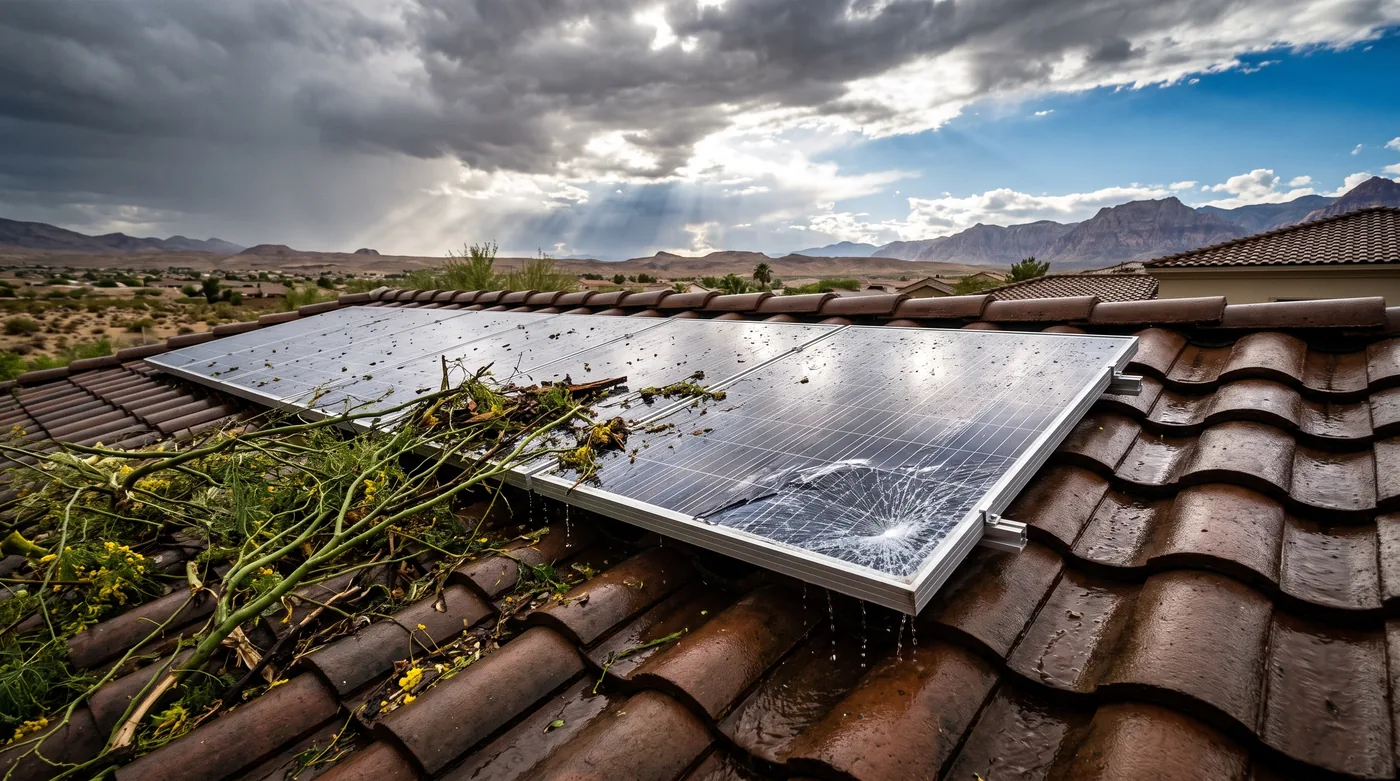
A roof mounted system you own is usually read into the dwelling section of a homeowners policy, the same section that covers the house and the things permanently attached to it. Usually is not a promise, and nobody at a solar company can make you one. Your policy decides, so the job is to ask your own carrier four specific questions and get the answers in writing before the panels go on the roof.
This page is about claims, not about selling you anything. We are electricians. We are not insurance agents, this is not insurance advice, and every general statement below is taken from the Nevada Division of Insurance's own published material, linked at the bottom.
Start with what a Nevada homeowners policy is actually made of
Most arguments about solar and insurance are really arguments about which section of the policy a thing falls into. The Division of Insurance's 2026 Consumer's Guide to Home Insurance defines the sections in plain words. These are its definitions, not ours.
| Section | What the Division says it does |
|---|---|
| Dwelling | "Pays for damage to your house and to the structures attached to your house. This includes damage to fixtures, such as plumbing, electrical wiring, heating and permanently installed air-conditioning systems." |
| Other Structures | "Pays for damage to fences, toll or storage sheds, freestanding garages, guest cottages and other structures not attached to your house." |
| Personal Property | Reimburses the value of your possessions, such as furniture, electronics, appliances and clothing. |
| Personal Liability | "Pays for legal defense if sued and financial loss if you are found legally responsible for injuries or damages to someone else." |
| Medical Payments | Pays medical expenses for people accidentally injured on your property, regardless of who is at fault. |
| Loss of Use | Pays some of your additional living expenses while the home is being repaired after a covered event. |
Two things follow from that table.
First, the dwelling definition turns on attachment and permanence, not on the word solar. The Division's list of fixtures is examples, and it does not name a photovoltaic system either way. A roof mounted array is bolted through the roof deck into the rafters and wired into the service panel, which is why it is commonly treated as part of the dwelling. A ground mounted array in the yard looks a great deal more like the Other Structures definition. Neither of those sentences is a coverage determination. They are the reason the question is worth asking out loud.
Second, the policy form matters. The Division's guide describes the common forms: an HO-3 Special Form is "a mixture of an open perils policy and named perils policy", where the house is covered for almost every peril except those specifically excluded and the contents are covered on a named perils basis. An HO-5 is open perils on both. A DF-1 Dwelling Fire Form covers only the dwelling, with no personal property or liability, and the guide notes it is the type of policy your mortgage lender will buy for you if you let your own policy lapse. Find your form number on your declarations page before you call anyone.
The guide is also blunt that "Homeowners' policies do not cover every risk to a house", and that flood, earthquake and war are standard exclusions requiring separate policies or endorsements.
Do you have to tell your carrier? Nevada does not make you. Tell them anyway.
Homeowners insurance is not required by Nevada law at all, as the Division's homeowners page says; mortgage lenders are what require it in practice. There is no Nevada statute that orders you to report a solar installation.
There are still two good reasons to report it, and both come straight out of the Division's guide.
The replacement cost of your house changed. The guide says it plainly: "Any changes to your home, such as the addition of a room, new insulation, new hardwood floors, etc." affect replacement cost, and it recommends coverage equal to the full replacement cost of your home. It also notes that many insurers require a home to be insured for at least 80 percent of replacement cost, and that failing to do so can bring a co-insurance penalty on partial losses. You have just permanently attached equipment to your roof. Whether or not it changes your premium, it is a change to the thing being insured.
The cancellation rule. The guide sets out when a company can cancel: for a new policyholder, for any reason within the first 70 days; after that, only if you do not pay your premium, "if you've lied on your application", or "if your risk has changed substantially". Non-renewal is separate, and the guide says a company that chooses not to renew must give you notice 30 days before the policy expires, and that you may ask for the reason.
Read those two together. Disclosure is cheap now and expensive later. Write to your agent, describe the system, and keep the reply. If the answer is that nothing changes, you want that in a file with the rest of the install documents.
The replacement cost trap, which is really about your roof
This is the part almost nobody raises before a solar sale, and it is the part that decides how a storm claim goes.
The Division's guide distinguishes replacement cost, "the amount it would take to replace/rebuild your home, or repair damages with materials of similar kind and quality without deducting for depreciation", from actual cash value, "the amount it would take to repair/replace damage to your home after depreciation". Its worked example is a roof:
Actual Cash Value: The amount it would take to repair/replace damage to your home after depreciation. For example, if your roof had a 30-year warranty; however, the roof is 28 years old, there will be depreciation for the age and condition of the roof.
Now put a 25 year array on a 20 year old tile roof. The panels have to come off and go back on for any roof work underneath them, and the cost of doing that is real. If your roof is near the end of its life, the honest sequence is roof first, panels second, and it is worth knowing which basis your policy uses before you decide.
Ask what basis your dwelling coverage is written on, and ask specifically whether your policy has a separate roof schedule or a wind and hail deductible different from the main one. Get the answer in writing.
What Nevada law does say, and where that protection stops
There is one clear rule here, and it runs the opposite way to what most people expect.
A utility cannot make you buy extra liability insurance just for having solar. NRS 704.774 says a customer-generator who obtains all necessary permits and whose system meets the safety and power quality standards of the National Electrical Code, Underwriters Laboratories Inc. and the Institute of Electrical and Electronic Engineers must not be required by the utility to comply with additional standards, perform additional tests, install additional controls, or "Purchase additional liability insurance, arising solely from the status as a customer-generator."
We checked this against the utility's own document rather than repeating it. NV Energy's Net Metering and Energy Storage Interconnection Handbook, version 7 dated 10/16/2025, contains no insurance requirement anywhere in it. The word does not appear.
That protection is written about a utility, and not everyone who sells you power is one. NRS 704.772 defines a utility as a public utility that supplies electricity in this State. A city-owned system is not one. Boulder City's own net metering policy says the customer "must maintain adequate insurance, and is solely responsible for, and agrees to indemnify the city and its employees against any loss arising from the design, construction, operation, or maintenance" of the system. If you are on Boulder City, Overton Power District No. 5, Valley Electric Association or Lincoln County Power, read your interconnection agreement for exactly this clause. There is more on those four in solar when your power company is not NV Energy.
Your interconnection agreement is a separate document from the handbook. Read the copy you sign. If it contains an insurance or indemnity clause, that is a term of a contract you agreed to, and NRS 704.774 speaks to what a utility may require of a customer-generator, not to every line of every agreement. Ask before you sign, not after.
Leased, financed, or third party owned systems
If you did not buy the system outright, the equipment on your roof belongs to somebody else, and that changes the question rather than answering it.
Nevada law already puts two things in your agreement. NRS 598.9821 requires an agreement for the lease or purchase of a system, and a power purchase agreement, to include an express written warranty on the installation and on the penetration into the roof, expiring not earlier than 10 years after installation. A lease or a power purchase agreement must also include an express written warranty that does not expire earlier than 10 years after installation. Those obligations sit with the company that signed them, which matters if that company goes quiet. That situation is covered in your solar company went out of business.
What is not settled by statute is insurance. Take these six questions to the system owner and your own carrier, separately, and get both answers in writing.
- Who insures the equipment itself against physical damage: the owner, or me?
- Does the agreement require me to carry insurance, to name the owner as an additional insured, or to add a loss payee?
- If the equipment causes damage to my home or injures someone, whose insurance responds first, and what does the agreement say I have indemnified?
- Who pays the deductible on a claim that involves the equipment?
- What happens if I need the roof replaced: who removes and reinstalls, and who pays for that?
- What has to be done when I sell the house, and what does the owner require of the buyer?
Question five is the one that bites in this valley, because a Las Vegas roof gets replaced on its own schedule and nobody plans for it on the day they sign.
Liability, which is the part nobody asks about
The Division defines personal liability as the section that pays for legal defence and for financial loss if you are found legally responsible for injuries or damages to someone else. An array is equipment attached to a roof above a driveway, a side yard and a neighbour's fence.
We are not going to tell you how a carrier would treat that, because we do not know and nobody selling solar does. The question to put in writing is simply this: does my personal liability coverage respond in the same way with a customer-owned generating system on the roof, and is there any endorsement or exclusion I should know about? One sentence, one written answer, filed with the contract.
The written record to build on install day
You will be asked for documents eventually, either by a carrier or by a buyer's agent. Collect them while they exist.
- The building permit and the passed final inspection card from your jurisdiction.
- The Permission to Operate notification from your utility.
- The equipment list with panel and inverter makes, models and serial numbers.
- The written installation and roof penetration warranty NRS 598.9821 requires, and the component warranties.
- Photographs of the roof before the array went on and after, and of the service panel before modification.
- The email from your agent confirming what you disclosed and what you were told.
Keep them somewhere that is not the installer's customer portal.
If your carrier will not answer, or denies a claim
The Nevada Division of Insurance's Consumer Services Section is the state agency for this. Its own guidance is to try to resolve the matter with the insurer first, then to bring it to the Division.
- Southern Nevada office: 3300 W. Sahara Ave., Suite 275, Las Vegas, NV 89102, (702) 486-4009.
- Toll free in Nevada: (888) 872-3234.
- Complaints are filed through the Division's secure online complaint form.
The Division says an investigator logs the complaint, sends an acknowledgement, and sends the complaint to the insurer or agent, and that "The insurance company generally must reply to the issues addressed in the Consumer Complaint and respond to the Division within 20 business days."
Be clear about the limits, which the Division publishes itself. Consumer Services cannot determine liability or valuation, cannot force a carrier to provide coverage, cannot force a carrier to change a coverage decision, cannot get involved in settlement negotiations, and does not provide legal representation or legal advice. It investigates potential violations of insurance law and regulation. That is a real power and it is not the same thing as winning your claim.
What we can do about any of this
Not much, and we would rather say so than pretend.
We cannot read your policy for you, we cannot tell you what your carrier will do, and we will not put a coverage claim in a proposal. What we can do is hand you a job file that answers the questions a carrier asks: a permit, a passed inspection, the equipment and serial numbers, a written installation and roof penetration warranty that meets NRS 598.9821, and photographs of the roof and the service panel before and after. If your quote from anyone does not include that paperwork, ask why before you ask about the price.
Questions people ask us
Does homeowners insurance cover solar panels in Nevada?
There is no single answer, because coverage comes from your own policy and not from state law. Nevada does not require homeowners insurance at all. The Division of Insurance's dwelling definition covers your house and structures attached to it, including permanently installed fixtures, which is the section most roof mounted systems are read into. Ask your carrier about your policy and get the reply in writing.
Do I have to tell my insurance company I installed solar?
Nevada law does not make you, but there are two practical reasons to. The Division of Insurance's guide says changes to your home affect its replacement cost, and it says that after the first 70 days a company can cancel a policy if your risk has changed substantially. Telling your carrier in writing removes the argument before a claim exists.
Who insures a leased or third party owned solar system?
Somebody else owns that equipment, so the answer is in two documents rather than one. Read the insurance and indemnity sections of your lease or power purchase agreement, and ask your own carrier how equipment you do not own is treated on your policy. Ask both in writing, and keep both replies with your contract.
Can NV Energy make me buy extra liability insurance for solar?
No. NRS 704.774 says a customer-generator who obtains the necessary permits and whose system meets the National Electrical Code, Underwriters Laboratories and IEEE standards must not be required by the utility to purchase additional liability insurance arising solely from the status as a customer-generator. We read NV Energy's interconnection handbook dated 10/16/2025 and it contains no insurance requirement.
What if a roof leak appears under the panels years later?
Two routes exist and they are separate. NRS 598.9821 requires your agreement to carry a written warranty on the installation and on the penetration into the roof that expires not earlier than 10 years after installation, so start with the installer. A claim on your own policy is a different question and depends on the cause of loss and your policy terms.
My insurer will not answer or has denied a claim. What now?
The Nevada Division of Insurance Consumer Services section takes complaints. Its Las Vegas office is at 3300 W. Sahara Ave., Suite 275, on (702) 486-4009, toll free in Nevada on (888) 872-3234. The Division says an insurance company generally must respond to it within 20 business days. It also says it cannot determine liability or valuation, or force a carrier to change a coverage decision.
Where these numbers come from
- Nevada Division of Insurance, Consumer's Guide to Home Insurance, 2026 edition checked 2026-09-20
- Nevada Division of Insurance, Homeowners' Insurance consumer page checked 2026-09-20
- Nevada Division of Insurance, File a Complaint, consumer complaint process and the 20 business day response checked 2026-09-20
- Nevada Division of Insurance, Consumers, what the Consumer Services Section can and cannot do checked 2026-09-20
- NRS 704.774, Permits and approvals; standards; utility prohibited from requiring certain customer-generators to meet additional requirements, and NRS 704.772, Utility defined, Nevada Revised Statutes as posted by the Nevada Legislature checked 2026-09-20
- NRS 598.9821, certain express warranties required in agreement, Nevada Revised Statutes as posted by the Nevada Legislature checked 2026-09-20
- NV Energy, Net Metering and Energy Storage Interconnection Handbook, version 7 dated 10/16/2025, which contains no insurance requirement checked 2026-09-20
- Boulder City, Net Metering Policy, which does require the customer to maintain adequate insurance and to indemnify the city checked 2026-09-20
We recheck this page annually. Last checked 2026-09-20. If a number here has moved, tell us and we will fix it the same week.