
Permits, HOAs and inspections
Install day on a Las Vegas roof, hour by hour
Why a summer crew starts at first light, what happens to your power mid day, what you need to move, and why the system does not switch on that night.
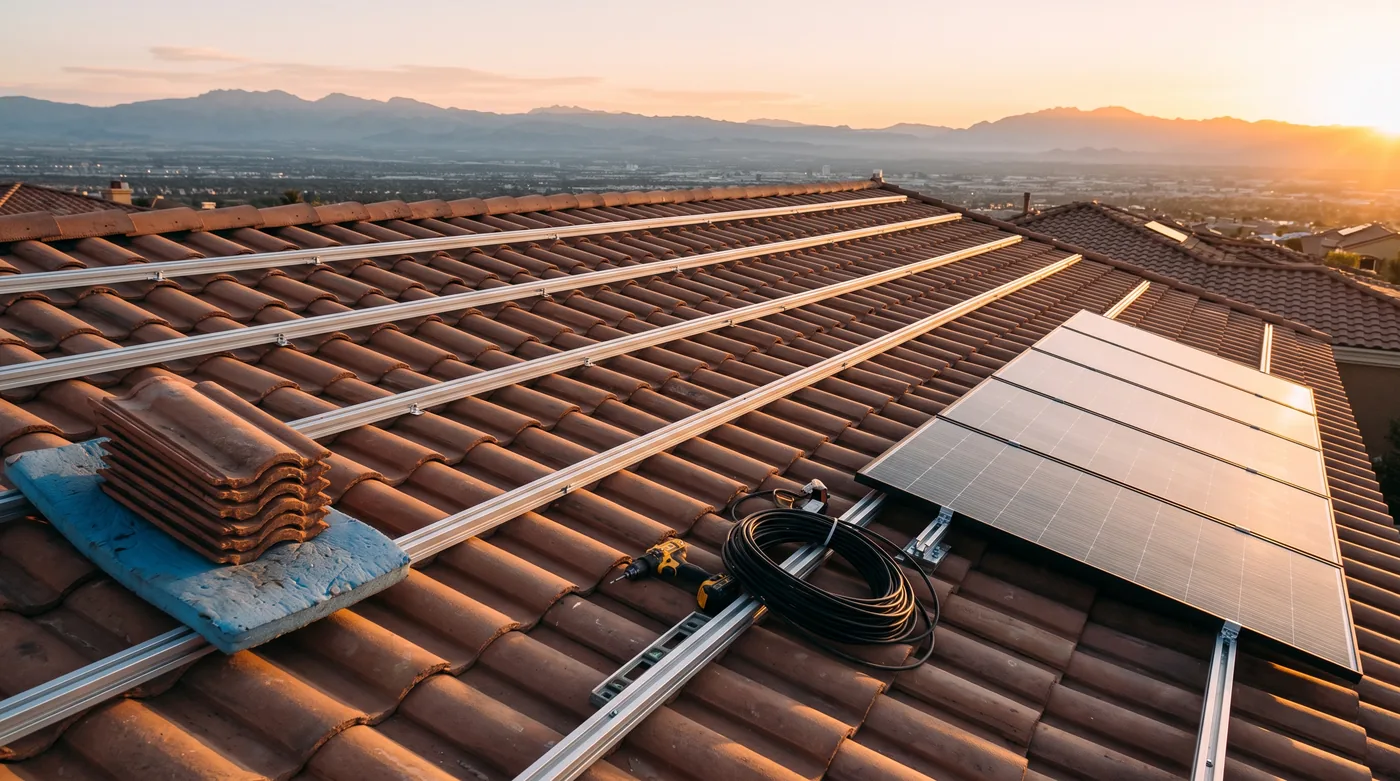
A typical residential rooftop system in this valley is one working day for a small crew. In summer that day starts at first light, because the roof becomes the worst place on the property by late morning. Your power goes off once, usually for a few hours around the middle of the day, while the system is tied into your main panel. When the crew leaves, the system is finished and switched off. It stays off until your building inspection passes and the utility sets the meter.
That last sentence is the one that gets left out of sales conversations. Everything below explains the day in the order it happens, and where it goes after the truck pulls away.
Before anyone arrives, two things are already done
Your permit is issued. Every jurisdiction in the valley requires a building permit for a rooftop array, and your address belongs to one of four desks: unincorporated Clark County, the City of Las Vegas, the City of Henderson or the City of North Las Vegas. Which one, and what each asks for, is set out in solar permits in Las Vegas, Henderson, North Las Vegas and Clark County. NRS 704.774 puts the obligation to obtain the permits on the customer-generator, which in practice means your contractor does it in your name.
Your interconnection application is in. NV Energy's application runs through its PowerClerk portal, and the handbook, version 7 dated 10/16/2025, says the application is incomplete until the fee is paid. In Southern Nevada that fee is $189, and if it is not received within 30 days of submission the application is cancelled. Application review, engineering review and metering technical review each run in a first ten business day window. If your design includes a battery, the handbook says a battery backup system on a grid connected system requires advance review and approval by NV Energy in its own right.
The design is fixed by this point. The layout on the roof was approved on paper, and the crew is building what the plan says, not what looks good on the day. If something on site genuinely has to change, that is a revision, not a decision to make from a ladder.
Why the day starts at first light from May to September
The roof is the hottest surface on the property, it faces upward, and it keeps getting hotter until late afternoon. Working it in a Las Vegas August is harder on the crew, harder on the adhesive and sealant used at the flashings, and harder on concrete tile, which gets more brittle the hotter and older it is.
So the day is built backwards from that. Roof work in the morning, ground level electrical in the afternoon, cleanup last. A crew that shows up at nine in July is either doing a small job or is going to be on your roof at two in the afternoon, and you can ask which.
There is a second reason, and it is about you. The power off window lands in the middle of the day. Starting at first light puts it earlier and gets your house back sooner.
The hour by hour
Times are approximate and shift with the season and the size of the system. The order rarely changes.
| Roughly | What is happening | Where the crew is |
|---|---|---|
| First light | Truck staged, driveway protected, ladders and fall protection set, tile stacking area laid out | Driveway and side yard |
| First two hours | Array area marked against the approved plan, tiles lifted and stacked, mounting locations found | Roof |
| Mid morning | Flashings set, mounts anchored, rails run and levelled | Roof |
| Late morning | Modules placed and clamped, module level electronics connected, DC conduit and roof penetration sealed | Roof |
| Midday | Power off. Main panel opened, connection made, AC disconnect set, conduit run to the meter, labels applied | Service panel and exterior wall |
| Early afternoon | Power back on to the house. System left off and locked out. Torque checks, continuity and insulation testing | Panel and roof |
| Mid afternoon | Tile reset and repaired, penetrations checked, roof swept | Roof |
| Late afternoon | Ground cleanup, magnet sweep for screws and fasteners, photographs for the inspection, walkthrough with you, inspection requested | Everywhere |
A crew leaving without the walkthrough and without telling you what broke is a crew you should ask about.
The power off window, and what it actually is
Tying a rooftop array into your house means opening the main service panel, which means the main breaker goes off. On most jobs that is all it is: your own contractor kills your own main, works the panel, and turns it back on. The utility is not involved and there is no appointment.
It is different when the service itself is being touched. If the main panel is being replaced, the main breaker de-rated, or the service upgraded, that can require the utility to pull the meter or disconnect the service drop. Nevada addressed this directly in 2025. NRS 704.7745 says that if a customer-generator asks the utility to temporarily disconnect and then reconnect electric service in relation to the installation of a net metering system, the utility shall schedule it within a reasonable time. That is a scheduled utility visit, usually a different day, and your quote should say plainly whether your job needs one.
Plan the day around the outage, not the other way round.
- Refrigerator and freezer: leave both shut. They will hold for a normal install outage.
- Internet, alarm panels, cameras, garage door openers and anything on a battery backup: they will drop and then come back. Some need a manual restart.
- Work calls and anything that needs a video meeting: move them. Do not assume a cellular hotspot solves it.
- Medical equipment that needs mains power: raise this at the site survey, in writing, not on the morning of the install. It changes how the day is sequenced.
- Thermostats: the air conditioning is off during the window. In July that is felt within an hour. Pre-cool the house early and keep doors shut.
Tile roofs, which is most of this valley
Most Las Vegas neighbourhoods are concrete tile, and tile is the single biggest difference between a Las Vegas install and one in a shingle market.
What happens to the tile. Tiles over each mounting location are lifted and stacked, not walked across. A flashing is set into the underlayment so water is shed over the top of it, and the tile is cut or reset around the mount. The array itself sits above the tile field on rails.
What the anchor actually grabs. This is worth understanding, because it is why the tile has to come off in the first place. Clark County's BD-PP-206, revised April 30 2026, sets out the criteria under which the Building Official may waive engineering for a residential install, and one of them reads: for wood construction, the supports "shall be anchored to solid roof rafters or to solid blocking with a minimum of one 5/16-inch (8 mm) diameter lag screw embedded a minimum of 2-1/2 inches (64 mm)." Nothing in that sentence mentions tile. The load path runs through the tile into the structure below it, which means the tile is lifted, the rafter is found, and the lag goes into wood.
The same section caps system weight at 4 pounds per square foot, requires panels mounted parallel to the roof plane and within 24 inches of the roof below, and limits connection points to 48 inches on centre. Anything outside that list needs sealed engineering calculations and installation details.
Breakage. Some tile breaks. A twenty year old concrete tile that has baked in Las Vegas sun since it was laid is brittle, and a crew moving a hundred of them will crack a few. What separates a professional job from a bad one is not zero breakage, it is three things: replacement tile on the truck, a count given to you before the crew leaves, and a contract that already said who pays for it. Ask that question at the quote stage.
The warranty that covers the holes. NRS 598.9821 requires an agreement for the lease or purchase of a system, and a power purchase agreement, to include an express written warranty on the installation and on the penetration into the roof, expiring not earlier than 10 years after installation. On a tile roof, that is the clause that matters most. Read it before you sign, and keep it.
Fire pathways, setbacks and labels, which is why your array is the size it is
If you have ever wondered why your designer left a strip of empty roof, this is why. BD-PP-206 requires not fewer than two 36 inch wide pathways on separate roof planes, running from the lowest roof edge to the ridge, with one of them on the street or driveway side. Each roof plane carrying an array needs its own 36 inch pathway. At the ridge, an array covering 33 percent or less of the plan view roof area needs an 18 inch setback on both sides, and above 33 percent it is 36 inches. Where the dwelling has an automatic sprinkler system installed to the fire code, those coverage thresholds move to 66 percent.
Panels may not be placed below an emergency escape and rescue opening, and a 36 inch pathway to that window is required.
The county also sets the rapid shutdown labelling, with the label located within 3 feet of the service disconnecting means it operates. Those labels go on during the day, and an inspector will look for them.
On the electrical side, the same policy says no electrical plan review is required for systems that do not exceed 5 kW, and engineer-designed plans are required for any new system of 25 kW DC or greater.
What you need to do, and it is short
- Clear the panel. Three to four feet of open floor in front of the main service panel, any sub panel, and the attic hatch if the crew needs it. Move the shelving, the bikes and the recycling the night before.
- Move the cars. The driveway is the staging area, the tile stack and the cut station. Park on the street the evening before, not at seven in the morning.
- Pets inside, and tell the crew. The side gate will be open for most of the day and people will be walking through it carrying panels. Dogs go in a back room, not the yard.
- Open up whatever is locked. Side gate, garage, roof access if there is any, and the electrical room if the panel is behind a locked door.
- Be reachable. You do not need to hover. You do need to answer a phone if something on the roof is not what the plan assumed.
- Stay off the roof. All day. Including the walkthrough, which is done from the ground.
Expect noise. A hammer drill into a stucco wall for the conduit run is loud, and it happens once.
Why the system is off when the crew leaves
This is the honest expectation to set, and it is the reason to read the rest of this page before you sign anything.
NV Energy's handbook is explicit on both points: "Systems may not be energized prior to successful final verification by NV Energy", and "The customer will not receive kWh credit for energy put back into the grid until the NV Energy meter(s) is set."
Here is the sequence after install day, from the handbook itself.
- Your building department does its final inspection. That is your jurisdiction's inspector, on your jurisdiction's schedule, not the utility's.
- The final inspection card goes to NV Energy. The handbook is specific that it must come from the local jurisdiction and show the date of the satisfactory final inspection, and that the passed inspection results are a separate document from the permit. The interconnection agreement goes up with it.
- Documentation review and inspection, the second ten business day window. NV Energy confirms the project details, then the metering team sends a technician to inspect and set the required meters. If the technician finds a problem, the project moves to a corrections status and gets re-inspected afterwards.
- The meter is set, and Permission to Operate is emailed. After the utility inspection passes and all required meters are set, a Permission to Operate notification goes to everyone on the application.
- Your account moves to the net metering rate. The handbook says the account is placed on the applicable net metering rate after the project receives Permission to Operate. For a new system of 25 kW or less that default is NMR-405 Tier 4, which is covered in what 75 percent of retail actually costs you.
So: two more appointments at least, neither of which is on your calendar on install day, and a stretch of time where there are panels on your roof doing nothing. That is normal. What is not normal is an installer who did not tell you it was coming.
One more line from the handbook worth knowing before you choose anybody: interconnections must be performed by a Nevada licensed C-2 or C-2g electrical contractor, and if a contractor's licence is expired, suspended or revoked, the authority having jurisdiction will not conduct the permit inspection. A lapsed licence does not just embarrass your installer, it stops your job at the inspection.
What a finished job looks like from the ground
You can check most of this yourself, before the inspector does.
- Two clear 36 inch pathways from the lowest roof edge to the ridge, one on the street or driveway side.
- A visible gap along the ridge, 18 inches at 33 percent coverage or less.
- No panel below a bedroom egress window, and a clear path to it.
- Conduit runs straight and level, strapped, with no sagging spans.
- A rapid shutdown label within 3 feet of the service disconnecting means, plus the DC conduit marking along the run.
- An AC disconnect that a person can reach and operate.
- Tile field reset, with no loose or obviously cracked tile left in place.
- A clean driveway, and a magnet run over it.
Take photographs of all of it the day the work finishes. You will want them for the inspection, for your records, and for the conversation in what your homeowners insurance does and does not cover once you have solar.
What we will and will not tell you about our own crew
We are a licensed Nevada electrical contractor and have been since 2013, and you can check that on the Nevada State Contractors Board site before you speak to us. Rooftop solar is a newer line of work for us, and we are not going to print a job count, a testimonial or a photograph of somebody else's roof to suggest otherwise.
What this page describes is not our marketing version of an install day. It is the process that the county policy, the state statute and the utility handbook require of every licensed installer working in this valley, with each of those documents linked below so you can read them yourself. Hold whoever you hire to it, including us.
Questions people ask us
How long does a solar installation take?
A typical residential rooftop system in the Las Vegas valley is one working day for a small crew, sometimes two if the main panel is being upgraded, if the roof is complex, or if a battery is going in. The install is the short part. The permit before it and the inspections after it take considerably longer than the day the truck is at your house.
Will my power be off while solar is installed?
Yes, for part of the day. Tying the system into your main service panel means the main breaker goes off. On most jobs the crew does that themselves and the outage is a matter of hours. If the service itself is being replaced or upgraded, that involves the utility and is usually a separate appointment.
Do I need to be home for the solar installation?
Somebody over 18 should be reachable, and present for the part of the day when the crew needs access to the main panel, the sub panel, the attic or a locked side gate. You do not need to watch the roof work, and you should not go up on the roof at any point.
Does the system turn on the same day it is installed?
No, and anyone who says otherwise is misleading you. NV Energy's interconnection handbook states that systems may not be energized prior to successful final verification by NV Energy, and that you do not get kilowatt hour credit for anything sent back to the grid until the NV Energy meter is set. Your local building inspection comes first, then the utility.
Why do solar crews start so early in the summer?
Because the roof is the hottest working surface on the property and it gets worse every hour. Roof work in a Las Vegas July is scheduled to finish in the morning, with the ground level electrical work and clean up in the afternoon. A first light start is a safety and workmanship decision, not a courtesy problem.
Will they break my roof tiles?
Some concrete tile breakage is normal on an older Las Vegas roof, because the tile is brittle after years of sun. A crew should bring replacement tile, tell you what broke before it leaves, and reset the field. Your contract should say who pays for replacement tile, and NRS 598.9821 requires a written warranty on the installation and on the penetration into the roof for not less than 10 years.
What happens to my internet and my refrigerator during the outage?
Both go off with everything else. Keep the refrigerator and freezer closed and they will hold for the length of a normal install outage. Move any call, any medical device that needs mains power and any work that depends on the internet off that day, and say so at the site survey if somebody in the house depends on powered equipment.
Where these numbers come from
- Clark County Building Department, Solar Photovoltaic Requirements, policy BD-PP-206, effective 09/15/2014, revised 04/30/2026 checked 2026-09-20
- NV Energy, Net Metering and Energy Storage Interconnection Handbook, version 7 dated 10/16/2025 checked 2026-09-20
- NRS 704.7745, final inspection by utility and temporary disconnection and reconnection of electric service relating to installation, and NRS 704.774, permits and approvals, Nevada Revised Statutes as posted by the Nevada Legislature checked 2026-09-20
- NRS 598.9821, certain express warranties required in agreement, including the warranty on the penetration into the roof, Nevada Revised Statutes as posted by the Nevada Legislature checked 2026-09-20
- Nevada State Contractors Board, licence search and residential solar resources checked 2026-09-20
Actual utility rates may go up or down and actual savings may vary. Every figure on this page is an estimate based on the sources listed below, not a promise about your home.
We recheck this page quarterly. Last checked 2026-09-20. If a number here has moved, tell us and we will fix it the same week.